ELECTROLOGYWORKS CONSULTATION
It can be frustrating to deal with the problem of having unwanted hair, choosing what type of hair removal to get, seeking an Electrologist, and understanding the nature of electrolysis treatments. The information found here should help you understand some of the factors causing your hair problem, and it should help you learn what to expect from your treatments. The consultation for electrolysis treatments can also be a first screening for other health related problems. The in-office consultation is free and there is no obligation on your part. A free phone consultation is also available.
FIRST VISIT
At your first appointment, you fill out a form that asks the basics such as name, address and contact information. Read more about your first appointment. There are specific questions about hair removal methods you have already used and some general health questions. These questions include:
- Areas to be treated
- What types of hair removal used
- How often is the hair being removed
- Medications which may cause unwanted hair growth
- Surgeries which may have contributed to hair growth
- Endocrine system and other hormonal changes that may have contributed to hair growth
This information is requested so that your hair problem and its possible cause can be evaluated. Information given at the consultation will help determine if any contra-indications exist for your specific hair problem. All of the information shared during the consultation and treatments will be kept in the strictest confidence.
TREATMENT AREAS FOR WOMEN AND MEN
Many areas of the face and body grow excess hair, which can be considered a cosmetic problem. For women, excess hair on the chin and throat, upper lip, center chest as well as lower abdomen can indicate hormonal factors, which can result in hair growth throughout your life. These hormonal factors can also point to some other health related problems, which would indicate that you should discuss your hair problem with a physician. Barbara will continue to evaluate this hair growth as treatments progress. For men, permanent hair removal via electrolysis treatments is a welcome relief to the unsightly or uncomfortable hair that occurs with genetics and testosterone.
Click here to see what areas can be treated.
WOMEN'S HORMONES
Excess hair on the chin, throat, upper lip, center chest, and lower abdomen can indicate that there are hormonal factors causing the excess hair growth, or it can indicate a sensitivity to circulating androgens (the normal male hormones that are present in women). Barbara does not diagnose medical disorders but has been the first step in screening for certain health problems for many of her clients.
The health history form will ask at what age you first noticed the excess hair growth. Puberty, pregnancy, surgical- and age-related menopause are the most common times for women to notice new hair growth.
The frequency of your menstrual cycle can indicate hormonal imbalances. Polycystic Ovarian Syndrome (PCOS) is the cause of excess hair growth in many women. This syndrome can be an indication of other disorders related to fertility problems and heart health.
You will be asked if you have had a history of fertility problems, hormonal or endocrine disorders, scalp hair loss, weight gain, family history of similar hair growth, irregular periods, acne or eating disorders. Barbara may recommend discussing these problems with your physician if you have not already done so.
CAUSES OF HAIR GROWTH
The consultation helps Barbara in evaluating your hair problem and designing a treatment program. Women often blame the prior methods of hair removal for their current hair growth, but the fact is there are genetic, hormonal, and lifestyle factors involved in increasing hair growth.
The following list describes causes of excess hair growth in women.
- Excessive production of androgens by the ovaries (PCOS: Poly-Cystic Ovarian Syndrome, tumor)
- Excessive sensitivity of hair follicles to androgens (genetic)
- Excessive production of androgens by the adrenal glands (NCAH: Non-Classic Adrenal Hyperplasia, tumor)
- Insulin Resistance
- Hyperandrogenism, Insulin Resistance, Acanthosis Nigricans (HAIR-AN)
- Excessive production of cortisol by the adrenal glands (Cushing's Syndrome)
- Menopause
- Medications
Excess hair growth on a woman's face usually begins with a few coarse hairs on the chin or upper lip. Some women will never have hair growth increase past the Grade 1 shown below, while other women will advance to Grade 4 over time. The length of time for electrolysis treatments to be completed will depend entirely on how much hair "Mother Nature" has destined for you to grow. One person can be finished with their treatments in 6 to 9 months while another person can take 18 to 24 months or longer. If you start electrolysis in Grade 1, but are destined to be Grade 4 (without intervention) then you might seek electrolysis treatments throughout the rest of your life.
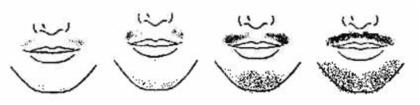
Grade 1 Grade 2 Grade 3 Grade 4
TRANSGENDER CLIENTS WELCOME
Consultations, treatments, and post-LASER sessions are available. Barbara can also refer you to the area support group.
HAIR GROWTH FACTS
Hair grows through an opening in the skin called the HAIR FOLLICLE. Scientists have determined that the human body is born with anywhere from 5 to 20 million hair follicles. Fortunately, for most people, only a small percentage of these follicles will ever produce noticeable hair. 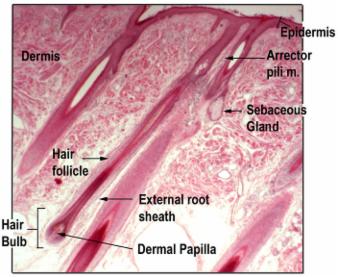
In childhood, our bodies are covered by VELLUS hair except for the scalp, brows and eyelashes. Vellus hairs are short, fine, lightly pigmented and have no medulla. During puberty, hormones cause vellus hair to convert to TERMINAL hair in the axilla and pubic areas. For some women, the vellus hair on their face will become ACCELERATED VELLUS which can then convert to terminal hair such as the hair represented in Grades 1 through 4 above.
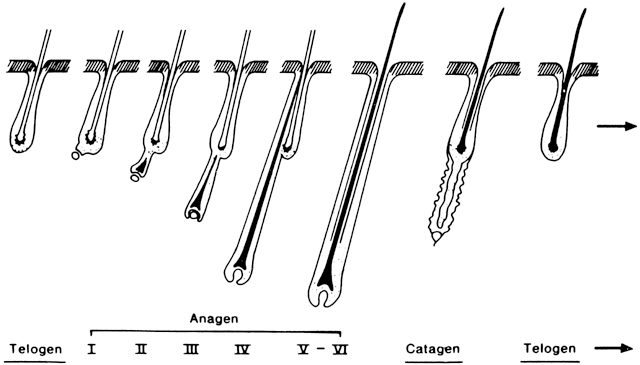
Hair grows in CYCLES that do not coincide with one another. This cycle is a constant growing and shedding of all hair on your body. Each individual hair then goes through four specific stages of growth. The follicle with a growing hair is in the ANAGEN stage. Anagen growth (when not cut off) can be seen as hair with a soft tapered ends. It can be 2 to 5 millimeters deep and can grow to be several feet in length as seen in scalp hair. The length of anagen hair growth is determined by genetics and health. The second stage of the cycle is CATAGEN, a short transition period when the hair stops growing, stops producing pigment and releases from the papilla in preparation to shed from the follicle. As catagen comes to an end, the root sheath rises in the follicle and forms a "collar" around the hair - sometimes called a "club" hair. Severe stress and environmental factors such as hormones, medications and trauma can cause hair to transition to the catagen stage. The third stage of a hair's life is TELOGEN where the follicle is shallow, but the hair may still be sitting in the skin as a "club" hair. A hair in telogen can sit on the skin for months before shedding. The shedding stage is called EXOGEN.
THE SECRET TO TREATMENT SUCCESS
Removing your hair soon after it appears through the skin will help you to complete your treatments in the quickest time possible. An area with a few scattered hairs that have not been tweezed can wait 2 - 4 weeks between treatments. For abundant hair growth and frequently tweezed areas, you might expect to schedule weekly clearings for at least 2 months. After an area is cleared in one session the length of the treatment will shorten, and the interval of time between treatments will lengthen. Clearing an area at least once a month will result in treatment of anagen-hair follicles, which will help you reach your goal faster.
Once you have begun treatments it is essential to stop any tweezing, waxing or threading of the area to be treated, as this results in prolonging the length of time it will take to complete your electrolysis treatments. Clipping or shaving is fine, as it only removes hair at the surface of the skin. Please do not shave for at least 24 hours prior to a treatment.
Please note that if you tweeze frequently and then stop tweezing - it will appear as if MORE hair is growing in. This is simply the result of your hairs continuing their stages and cycles without interruption. Schedule your electrolysis treatment as soon as you can so that the hairs will not shed.
SCHEDULE NOW!
Website and contents copyright © Barbara Greathouse. All Rights Reserved.